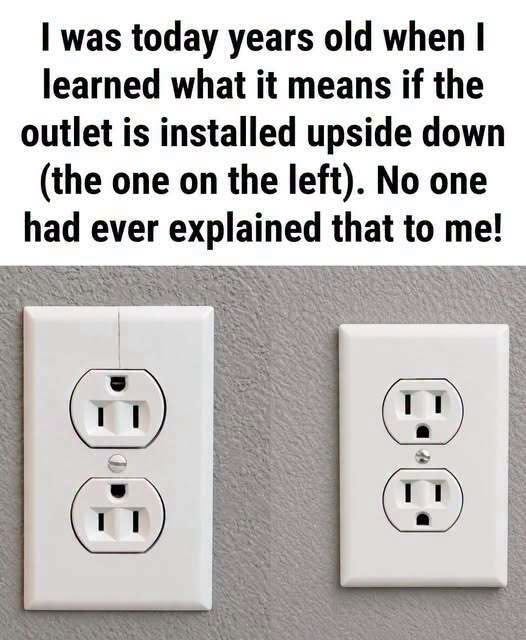
For decades, millions of homeowners have walked past their living room walls, plugged in their electronics, and remained completely oblivious to a terrifying electrical hazard hiding right in front of their eyes. Look closely at your baseboards right now. If you spot a wall outlet flipped completely upside down with the ground hole pointing toward the ceiling, you are looking at either a genius safety masterpiece or a ticking time bomb. Electricians have spent years keeping quiet about this shocking architectural quirk, but the truth behind why some outlets are installed in reverse is finally coming to light, and it will completely change the way you look at your home forever!
At first glance, an upside-down wall outlet looks like the ultimate blunder of a lazy, incompetent contractor. To the untrained eye, it appears to be installed completely backward, mocking every standard design principle of modern construction. Homeowners often stare at these inverted sockets with annoyance, assuming someone simply rushed the job or lacked basic attention to detail. However, seasoned master electricians know that this unusual orientation is rarely a mistake. Instead, it is a deliberate, highly calculated engineering choice designed to solve specific household dilemmas, prevent electrical hazards, and manage complicated legacy wiring systems that date back generations.
To truly understand this bizarre phenomenon, we have to look back at the architectural evolution of residential homes. In older properties built decades ago, ceiling lights were far from standard, especially in sprawling living rooms and cozy bedrooms. Interior designers and builders had to find clever ways to illuminate dark spaces without installing expensive overhead fixtures. The brilliant solution of the era was the switched wall outlet. Builders would wire a specific socket so that half of the receptacle remained constantly energized, while the other half was wired directly to a wall switch near the door. This allowed homeowners to walk into a dark room, flip a switch, and instantly power a plugged-in table lamp.
Because these switched outlets looked identical to normal, unswitched outlets, they caused endless confusion for residents who couldn’t figure out why their alarm clocks kept shutting off every time someone hit the wall switch. To solve this identification problem, clever electricians began installing the split-controlled outlets upside down. The inverted ground hole served as an immediate, silent visual cue to anyone in the house that this specific receptacle functioned differently than the rest of the standard plugs. While it was never an official mandate, this informal industry custom spread rapidly across various regions, becoming a secret language among electrical professionals.
Despite its clever origins, there is a massive misconception that an upside-down orientation is universally required by law for safety reasons. In reality, the National Electrical Code contains no such rule mandating that receptacles must face a specific direction. Electricians, builders, and regional contractors are entirely free to choose whatever orientation fits their aesthetic preference or project requirements. Consequently, finding an upside-down outlet in a modern home does not automatically mean it is connected to a wall switch. In many contemporary builds, it is simply a stylistic choice favored by interior designers or a localized habit passed down through generations of regional trade workers.