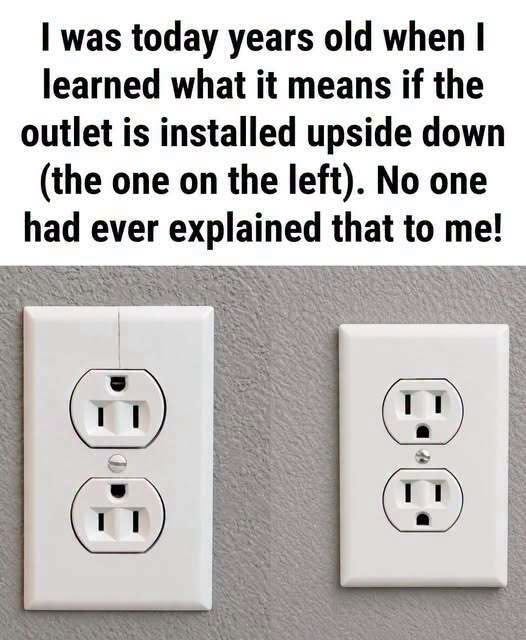
Beyond the historical context of switched receptacles, safety plays a surprisingly profound role in the debate over outlet orientation. Many safety advocates and industrial electricians argue that mounting an outlet with the ground pin facing upward offers a crucial layer of physical protection against falling metal objects. Imagine a scenario where a metal plug is only partially inserted into a standard upright outlet, leaving the hot and neutral prongs slightly exposed. If a metallic object, such as a stray coin, a piece of jewelry, or a metal necklace, happens to slide down the wall, it could bridge the gap between the live prongs and trigger a catastrophic short circuit, severe electrical shock, or even an intense domestic fire.
When the outlet is flipped upside down, the ground pin sits prominently at the top. If a metal object falls downward against the faceplate, it first strikes the grounded prong, which is completely safe and harmless, effectively neutralizing the danger before it can ever reach the live electrical currents. While modern faceplates and plugs are engineered to minimize these risks, this safety logic has convinced many hospitals, commercial buildings, and safety-conscious homeowners to adopt the upside-down configuration across their entire properties.
Ultimately, what initially looks like a bizarre construction error is usually a window into a rich history of practical problem-solving. Whether it was deployed to signal a switched circuit, implemented as a proactive safety defense against falling debris, or simply chosen for aesthetic alignment by a unique builder, the upside-down outlet serves a very real purpose. The next time you spot one of these inverted sockets in your hallway or kitchen, you can rest easy knowing it is not a mistake at all, but rather a silent guardian of home electrical design.