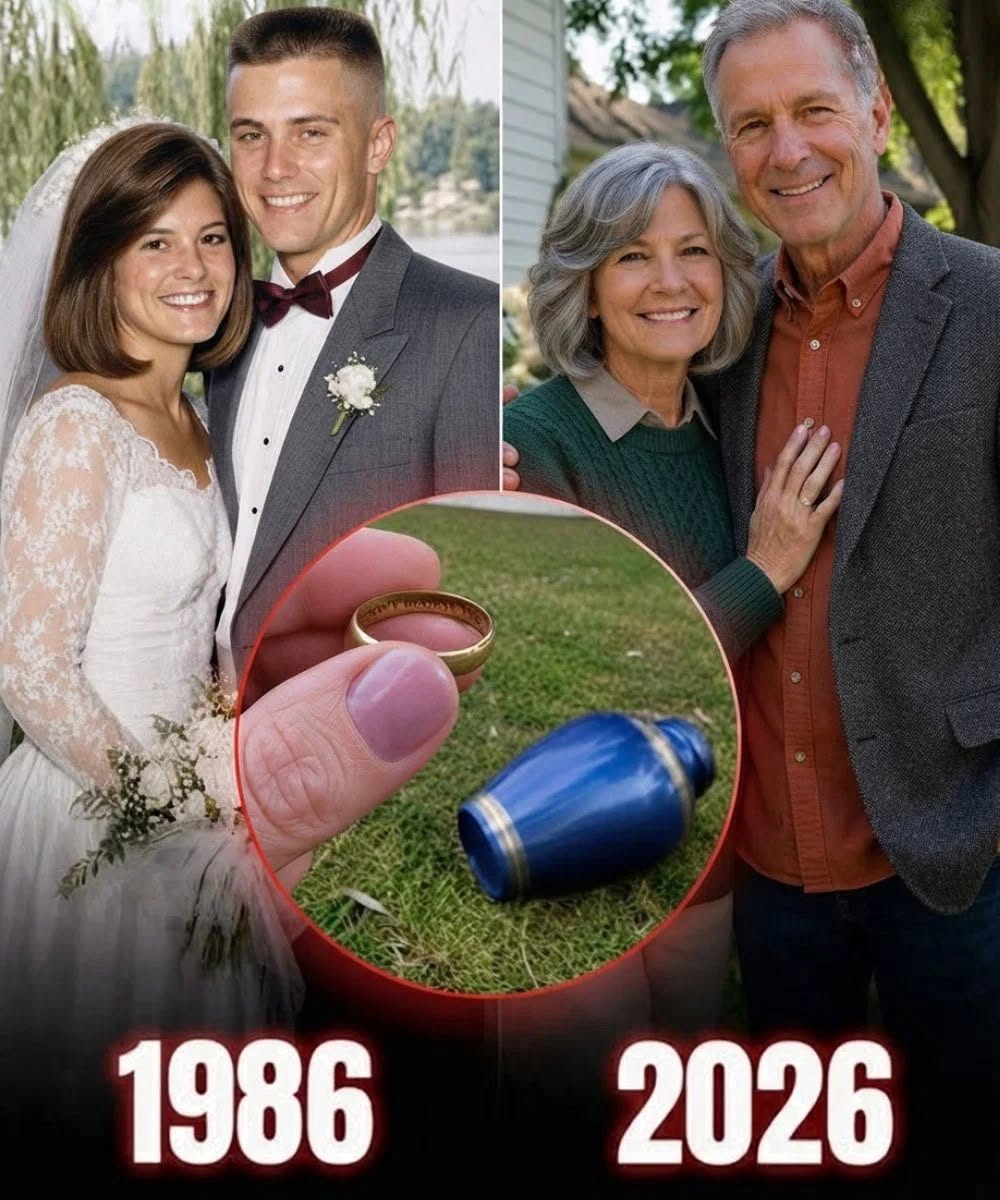
After forty years of marriage, I believed there was almost nothing about my husband I didn’t know.
Then Frank died while visiting his daughter overseas, and when his ashes finally came back to me, something hidden inside the urn made me question everything about his last days.
After four decades together, I had always imagined that when Frank died, I would be beside him, holding his hand through the final goodbye.
Instead, I learned I had lost him through a phone call from thousands of miles away.
Frank had traveled abroad to stay with Claire, his daughter from his first marriage. Their relationship had been distant and difficult for years, but recently something had changed. They were speaking almost every week, slowly rebuilding what had once been broken.
When he told me he wanted to spend three weeks with her, I encouraged him to go.
“You should,” I said. “You’ve already wasted too many years missing each other.”
Frank kissed my forehead and smiled.
“Forty years married to me, and you’re still trying to send me away.”
“Only for three weeks, Frank.”
Six days later, Claire called me in tears.
“Diane, Dad collapsed.”
I sat down before she even finished speaking because something in her voice had already told me what was coming.
“Is he at the hospital?”
There was a long pause.
“No. He’s gone.”
I remember very little about the minutes that followed.
Claire told me an ambulance had arrived quickly. She said the paramedics had tried, but there was nothing they could do.
I immediately started searching for flights.
“No,” Claire said. “Please don’t come.”
“What do you mean, don’t come?”
“There’s nothing you can do here. The hospital paperwork is a nightmare, and you’ll only be alone while I deal with everything. Let me handle Dad.”
“I should be there.”
“I know.”
Her voice cracked.
“Please let me do this for him.”
Maybe grief makes people easier to guide. Maybe I trusted the woman Frank had spent so many years trying to reconnect with more than I should have.
Whatever the reason, I stayed home.
Claire organized the cremation.
The days between Claire’s call and the arrival of the urn passed in a blur. People brought casseroles I barely touched. Neighbors knocked on the door, spoke softly, and told me stories about Frank that I already knew. At night, I would wake up and reach toward his side of the bed before remembering there was no reason for him to be there. I kept thinking about his suitcase, his favorite sweater, and the reading glasses he had packed at the last minute. Every ordinary object seemed suddenly important because it belonged to a life that had ended somewhere I had never seen.
I also replayed my final conversation with him. Frank had called from Claire’s house the night before he died. He sounded tired but cheerful. He told me Claire had made dinner, complained that her coffee was terrible, and promised he would bring me something ridiculous from the airport gift shop. Nothing in his voice suggested fear. Nothing sounded like goodbye. That made the silence afterward even harder to understand.
She promised me Frank would be returned to me.
Two weeks later, a package arrived at my door.
Inside was a pale-blue ceramic urn.
Blue had always been Frank’s favorite color.
I sat on the living-room floor, held the urn against my chest, and cried until my throat burned.
Years earlier, Frank and I had made a promise.
Whichever of us died first would have their ashes scattered beneath the willow tree beside the lake where we had first met.
It took me another month before I could make myself go.
I chose a quiet morning when I knew no one else would likely be there.
I sat beneath the willow branches with the urn resting in my lap.
“I hate you for going first,” I told him.
Then, despite myself, I laughed.
“You always were selfish.”
I began telling him about everything he had missed: the kitchen faucet that had started leaking, our neighbor’s new dog, and the ridiculous fact that I still expected to hear his key turning in the front door at six every evening.
Talking to an urn felt absurd at first.
Then it stopped feeling absurd.
For a few minutes, I could almost imagine Frank beside me, interrupting whenever I became too sentimental.
Eventually, I lifted the lid.
Inside was a sealed bag containing his ashes.
I carefully raised it from the urn.
Something hard rattled against the ceramic bottom, slipped free, and fell onto the grass.
I looked down.
Frank’s wedding ring.
I knew that band better than I knew most things.
I recognized every scratch and worn edge.
Frank had worn it for forty years.
He used to joke that I was the only person allowed to remove it from his finger.
But Claire had specifically told me he had been cremated wearing it.
I picked it up.
Sunlight struck the inside of the band.
There were words engraved there.
My breath caught.
Frank’s ring had never had an engraving.
I turned it toward the light.
Three words appeared inside.
“DON’T BELIEVE HER.”
I read them once.
Then twice.
Then again.
Her.
Only one woman had been with Frank during those six days overseas.
Claire.
I didn’t call her.
Two days later, I boarded a plane.
As far as Claire knew, I was still at home grieving.
By the time I reached Claire’s street, I had spent the entire flight telling myself there might be an innocent explanation. Maybe the ring had been engraved years ago and I had somehow never noticed. Maybe Frank had meant someone else. Maybe grief was making me suspicious of a woman who had just lost her father. I repeated those possibilities until the taxi stopped. Then I saw Frank’s belongings inside the house, and every comforting explanation began falling apart.
When the taxi stopped outside her house, I nearly told the driver to keep going.
Then I noticed movement behind the front window.
A boy, perhaps twelve years old, was inside.
He was wearing Frank’s old baseball cap.
I recognized the ugly thing immediately because Frank had owned it for about thirty years and refused every suggestion that he replace it.
The boy was kneeling beside Frank’s open suitcase, carefully removing items from it.
My stomach tightened.
I got out and walked toward the house.
The front door stood open.
Several boxes were stacked in the hallway, and two men were carrying furniture toward a van.
Some boxes had FRANK written across the sides.
His shoes sat beside the staircase.
His travel bag was on a chair.
His cane leaned against the wall.
Claire had sent almost none of these things back to me.
For one wild second, I wondered whether the message in the ring was warning me about something far worse than an ordinary lie.
I stepped inside.
“Claire?”
She came out of the kitchen carrying a box.
The instant she saw me, she nearly dropped it.
Her first words weren’t hello.
“You weren’t supposed to come here.”
I stared at her.
“That’s an interesting thing to say.”
Her expression changed immediately.
“I meant I would have picked you up.”
“No, you didn’t.”
“Diane—”
“Why are Frank’s things still here?”
“I was planning to ship everything.”
“You told me the hospital lost most of it.”
Claire glanced toward the stairs.
That was when I noticed Frank’s phone lying on the kitchen counter.
I crossed the room and picked it up.
Claire moved toward me immediately.
“Give me that.”
I pressed the phone against my chest.
“You told me this was missing too.”
She stopped.
Neither of us said anything.
Then the boy appeared at the top of the staircase.
Frank’s cap was still on his head.
He looked at me, then at Claire.
“Mom?”
Mom.
Claire shut her eyes.
“Go upstairs, Eli.”
The boy studied me curiously.
“Who is she?”
“Upstairs. Please.”
He disappeared again.
I turned back to Claire.
“Who is that?”
She said nothing.
“Who is Eli?”
“My son.”
For several seconds, I honestly thought I had heard her wrong.
“Your what?”
“My son.”
I stared toward the stairs.
“You’re telling me Frank had a grandson?”
Claire began crying.
I didn’t.
Not yet.
“How old is he?”