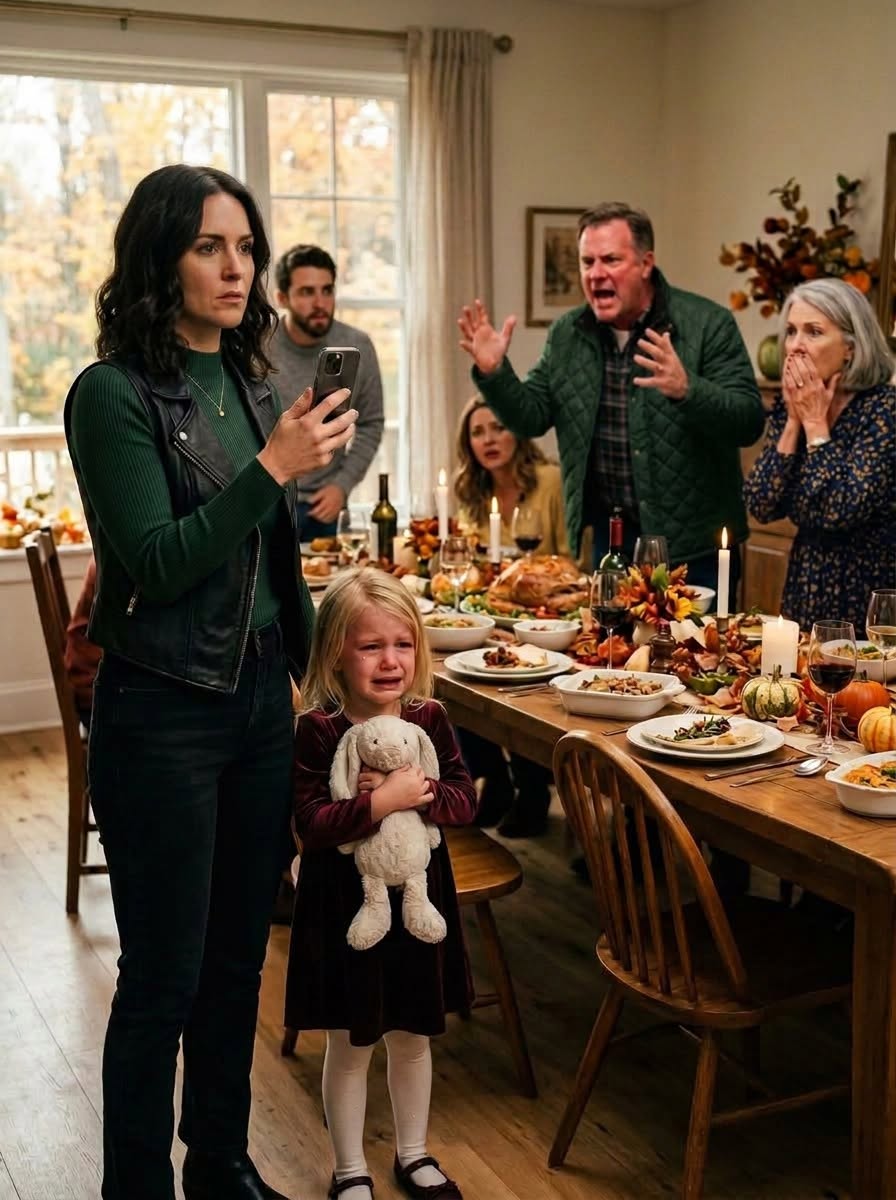
I held her more tightly.
“Grandpa was wrong,” I whispered. “The holiday was better the second we left.”
Then she began to cry.
Quietly at first.
Then in tired, shaking sobs.
I held her until the tears finally slowed.
Rather than returning home, we stopped at a roadside diner.
The waitress, Marlene, immediately noticed Lily’s puffy eyes and brought her hot chocolate covered with extra whipped cream.
“Rough Thanksgiving?” she asked gently.
“You could say that.”
Lily had pancakes for dinner.
I could barely taste my coffee.
My phone vibrated without stopping.
Mom: Please answer.
Dad: This has gone too far.
Mark: You are ruining everything.
Then another message from Mark: I’m sorry, okay? I said I’m sorry.
Finally, a text arrived from a number I did not recognize.
This is Nina Patel. I received confirmation that the documents were delivered. Do not speak to your father or brother without counsel. Call me when you are safe.
I kept staring at one particular word.
Safe.
It was remarkable how a single word could make me realize that I had not genuinely felt safe in years.
My family had never struck me.
They had never left physical marks.
Their harm was more subtle.
Jokes made at my expense.
Favors carrying hidden obligations.
Help later turned into debt.
Invitations transformed into interrogations.
Love offered with invisible conditions attached.
After my divorce, Dad had said,
“At least now you know what happens when you ignore advice.”
When Lily and I moved into a modest apartment, Mom smiled politely and called it “cozy.”
When I accepted the bookkeeping position, Mark joked,
“Try not to mess up the decimals.”
And I smiled.
Stayed silent.
Convinced myself I was protecting my child.
But as I watched Lily draw a turkey on the back of a receipt in that diner, I finally understood.
Peace created through silence is not real peace.
It is merely a place where the loudest person becomes comfortable.
After Lily fell asleep, I called Nina.
“You did the right thing,” she told me. “The bank already had concerns. Your documents gave them the missing trail.”
“What happens now?”
“The loan will likely be frozen. Investors notified. If the forged documents are confirmed, there may be both civil and criminal consequences.”
“My father is seventy-one.”
“Age does not erase a signature.”
“And Mark?”
“He put things in writing. That matters.”
The following morning, the pleading took a different form.
Mark called from his wife’s phone after realizing I had blocked his.
He did not bother greeting me.
“Claire, I’ll give you money.”
I gave a single laugh.
“That’s your apology?”
“Twenty thousand.”
“You think this is about money?”
“Fine. Fifty.”
“You can’t even get bank approval now.”
He went silent.
Then his anger returned.
“You have no idea what you’ve done.”
“I know exactly what I’ve done.”
“You think they’ll protect you? Nina? The bank? Alvarez? You’re nobody, Claire. You’re a divorced single mom in a rental apartment.”
I looked at Lily sitting at the table in her pajamas, eating cereal.
“No,” I said. “I’m the person who kept records.”
Then I disconnected the call.
By midday, Dad appeared outside my apartment.
Through the peephole, I saw him standing there in a wool coat, his appearance as immaculate as ever.
For a brief instant, I became the little girl who always expected punishment.
Then Lily spoke softly beside me.
“Is it Grandpa?”
“Yes.”
“Do we have to open it?”
That answered everything.
“No.”
Dad knocked again.
“Claire. I know you’re there.”
I sent Nina a message.
She responded immediately:
Do not open the door. Ask him to leave in writing.
So I did.
Me: Leave my building. Do not come to my home again without arranging it through my attorney.
I watched as he read the text.
His jaw tightened.
“You’re making a mistake,” he called through the closed door. “Family doesn’t do this.”
I answered loudly enough for him to hear.
“Family doesn’t throw a five-year-old out on Thanksgiving.”
Ten seconds later, he walked away.
After that, events unfolded rapidly.
Within one week, Hale & Turner suspended Mark.
The bank placed a freeze on the development financing.
Victor Alvarez withdrew from the project entirely and accused them of misrepresentation.
Investors demanded their money back.
Dad’s longtime business partner confessed that he had always been suspicious of the figures.
By December, Mark’s wife, Tessa, filed for separation.
I took no pleasure in it.
She had occasionally laughed at Mark’s cruel jokes.
But she had also spent too many dinners sitting silently with her eyes lowered toward her plate.
Sometimes people fail to recognize a cage until another person opens the door.
Mom came to see me once.
She knocked gently.
Stepped away from the door.
Held a purple gift bag.
I opened it while leaving the security chain attached.
“Hi, Claire.”
“Hi, Mom.”
She looked behind me.
“Is Lily here?”
“She’s at school.”
Mom nodded.
“I brought her Christmas gift.”
I did not reach for it.
Her eyes filled with tears.
“I should have said something.”
“Yes.”
“I was afraid your father would make a scene.”
“He made one anyway.”
She flinched.
For a moment, I expected her to defend herself.
Instead, she only said,
“I know.”
“I’m sorry,” she whispered. “Not just for Thanksgiving.”
Her words reached parts of me that had remained sealed for years.
Still, apologies do not remove an entire childhood.
They do not automatically restore trust.
“Thank you for saying that,” I replied.
“Can I see her?”
“Not yet.”
She nodded with sadness.
“Will you tell her I love her?”
“I’ll tell her you dropped off a gift.”
I closed the door softly.
I no longer needed to slam anything in order to be heard.
Christmas was peaceful.
Lily and I decorated a small tree.
She insisted on using rainbow lights because “white lights look too serious.”
We made misshapen cookies.
Watched films.
Cooked pancakes shaped like stars.
Lily called Grandma after breakfast because she wanted to.
I remained beside her throughout the conversation.
That became the first boundary we successfully maintained.
Many others followed.
Dad attempted to contact me through extended family members.
I referred all of them to my attorney.
Mark tried guilt.
Then rage.
Then public humiliation.
Nothing succeeded.
By February, Mark had been indicted on fraud-related charges.
Dad faced both civil lawsuits and criminal accusations.
Their lawyers advised them to stop contacting me.
For the first time in my adult life, months passed without my father criticizing me or my brother ridiculing me.
Dennis Kline helped me secure a better position working as a consultant in forensic bookkeeping.
“You notice what other people miss,” he said.
“That comes from being underestimated.”
“Then let’s make it useful.”
The work paid fairly.
It gave Lily and me stability.
By spring, she no longer asked whether Grandpa was angry.
She made new friends.
Lost her first tooth.
And still paused before taking bread from the basket at dinner.
Whenever she hesitated, I handed it to her first.
“Always take a roll,” I reminded her.
One evening after Lily’s school concert, Mom waited outside carrying a bouquet of daisies.
She had requested permission several weeks beforehand.
My conditions were straightforward.
She could not approach Lily unless Lily chose to engage.
She could not mention Dad or Mark.
And she could not pretend Thanksgiving had never happened.
Lily looked up at me.
“It’s your choice,” I said.
She walked toward Mom.
Mom knelt down.
“You sang beautifully.”
Lily took the flowers.
“Thank you.”
There was no emotional reunion.
Only a grandmother slowly learning that affection without respect is nothing more than performance.
One year after that Thanksgiving, I hosted dinner in my apartment.
The table was too small, so we pushed my desk against one side to create extra space.
Dennis attended.
Nina came.
Marlene arrived carrying two pies.
Mom joined us as well.
No one made a speech.
No one insulted anyone.
No child was mocked for reaching toward the bread.
Before we began eating, Lily raised her hand.
“I want to say something.”
She stood on her chair holding a dinner roll above her head.
“I’m thankful that Mommy lets me eat bread whenever I want.”
Everyone laughed gently.
Then she turned toward me.
“And I’m thankful we left.”
The room became quiet.
Not in a painful way.
The truth simply needed time to settle.
I took her hand.
“Me too.”
Later, once everyone had gone and Lily had fallen asleep on the couch, Mom stayed to help me wash the dishes.
Eventually, she said,
“Your father’s sentencing is next month.”
“I know.”
“He asked about you.”
“What did he ask?”
“Whether you were proud of yourself.”
I remembered Mark running barefoot behind my car.
Dad standing beyond the glass.
Lily crying in the back seat.
The email leaving my phone.
And all the years that had led to that moment.
Then I pictured my daughter standing proudly with a dinner roll held above her head.
“Yes,” I said. “I am.”
Mom nodded.
She did not challenge me.
That response told me more than any speech could have.
People later asked whether I regretted sending the documents on Thanksgiving Day.
They expected a complicated response.
They expected shame.
But regret belongs to those who wish they had chosen another path.
I did not.
I gave my father and brother years of opportunities.
Silence.
Patience.
Explanations.
Additional chances.
Apologies I never should have made.
Holidays they had not earned.
In the end, I reclaimed only one thing.
The truth.
They told me not to return.
So I never did.
And when they begged me to undo what I had done, they finally discovered what had taken me a lifetime to understand.
You can force someone out of your house.
But you cannot force them out of their own power.